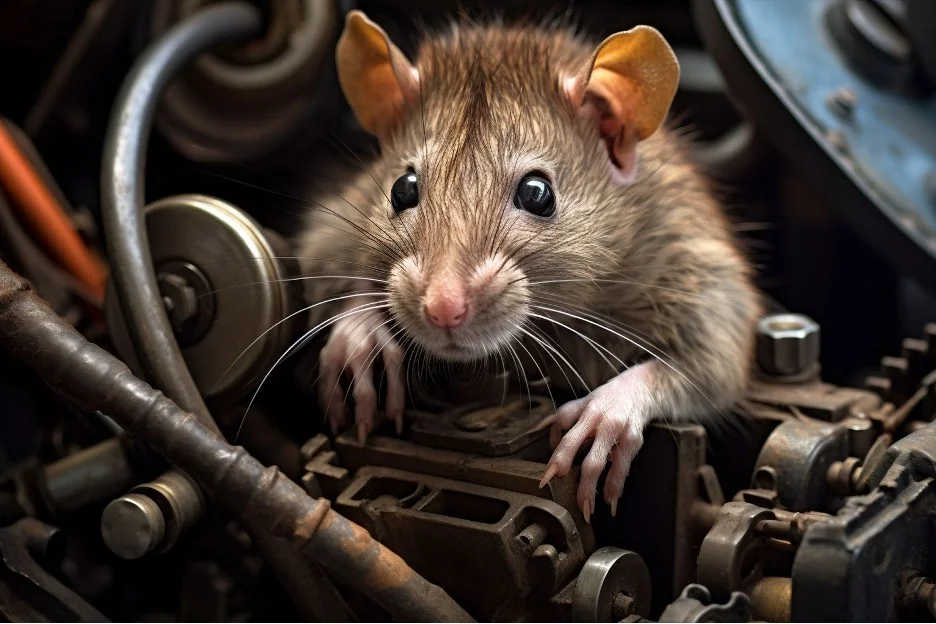
Rodents Are Destroying Brand-New Cars And It's Happening
Faster Than You Think
You buy a brand-new car. You park it. You come back to a
vehicle that won't start, with thousands of dollars in damage caused not by an
accident or a mechanical defect, but by a rat.
This isn't a rare horror story anymore. It's happening to
car owners across the United States, and the damage is far worse than most
people expect.
The Problem Is Growing, And Here's Proof
Recent reports from automotive news outlets paint a
startling picture of how serious this issue has become.
In one widely shared incident, a 2025 Toyota Sienna parked
on a Washington DC street for just 39 hours was found completely undriveable
after rodents chewed through its wiring, sensors, and insulation. The estimated
repair bill came to $13,000. The owner reported that neither the accelerator
nor the brakes were functioning, warning lights had flooded the dashboard, and
the headlight housing had been physically chewed through. The vehicle had to be
towed out of state for repairs. Other owners in the same online community
chimed in with similar experiences, one reporting $15,000 in rat damage to
their own vehicle.
The problem isn't limited to a single brand or model. A 2025
Kia K4 owner with just 10,000 miles on the odometer faced the same nightmare:
animals had crawled into the engine bay and chewed through wiring. The
dealership confirmed the damage. Fellow K4 owners responded saying the exact
same thing had happened to their vehicles.
And in yet another case, a 2025 Toyota Camry with only
10,000 miles had to visit the dealership four times in two weeks for a cascade
of unexplained warning lights, with one commenter pointing out that rodent
damage to communication cables can cause precisely this kind of widespread,
seemingly inexplicable electronic malfunction.
Why Are Modern Cars So Vulnerable?
This is where the story gets more troubling. It isn't just
urban parking conditions or bad luck. There's a structural reason why rodent
damage to vehicles has been climbing.
Many automakers have shifted toward eco-friendly, soy-based
materials in their wiring insulation, a well-intentioned green initiative that
has had an unintended consequence: rodents find these materials attractive,
often mistaking them for food or nesting material. Combine that with the warmth
of a recently driven engine bay, and you have conditions that are almost
purpose-built to attract rats and mice.
Modern vehicles also amplify the consequences of even minor
wiring damage. Older cars could lose a single function if a wire was chewed
through. Today's vehicles run on deeply interconnected electronic systems. If a
sensor goes down, it can cascade into failures across braking, acceleration,
airbag, and stability systems simultaneously. A small amount of rodent activity
can render an entire car undriveable.
And here's the part that stings most: standard manufacturer
warranties typically do not cover rodent damage, classifying it as an act of
nature. The repair bill lands entirely on the owner.
There Is a Better Way to Protect Your Vehicle
At CTech Corporation, we've been working on this problem for
years. Our product, Rodrepel™, is an extremely low-toxicity,
environment-friendly rodent aversive designed specifically to keep rodents away
from the applications they damage most, including vehicle wiring.
Unlike traps that stop working once they're full, poisons
that carry health risks to humans and pets, or ultrasonic devices that rodents
simply grow accustomed to, Rodrepel™ works through a smarter mechanism. It
triggers an instinctive aversion response in rodents, causing temporary
discomfort that teaches the animal to associate the treated surface with
something to avoid. This response is not only retained by the individual animal
but is passed on to others, creating a lasting deterrent effect.
Rodrepel™ is available in several application formats suited
to vehicle protection:
Our lacquer can be applied directly over
already-installed wiring, cables, and surfaces, creating a transparent, durable
coating that doesn't wear off easily. Our liquid concentrate can be
mixed into paints and applied across engine bays, garages, and parking areas.
Our spray offers a convenient, easy-to-apply solution for treating
specific areas where rodent activity has been detected.
The product is compliant with ROHS, ROHS2, REACH, ISO,
APVMA, NEA, EU BPR, and is FIFRA exempted, making it safe for use around
humans, pets, and the environment.
You've invested in your vehicle. Don't let a rat undo that
in just hours.
Contact us at technical.marketing@ctechcorporation.com
to learn more about protecting your car, home, and property from rodent damage.
Visit us at: www.ctechcorporation.com
| www.rodrepel.com | www.combirepel.com