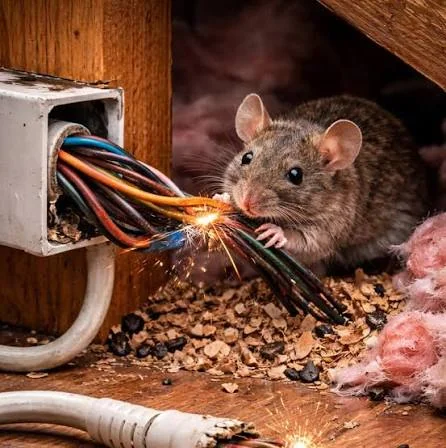
When Rodents Take Down the Power Grid: A Growing Threat
to Critical Infrastructure
Most people associate rodent damage with chewed furniture or
gnawed food packaging. But these small creatures are capable of something far
more dramatic: taking down power grids, cutting off internet access for entire
communities, and disrupting critical infrastructure for days at a time.
These aren't hypothetical scenarios. They are happening
right now, around the world.
The Problem Is Bigger Than You Think
In Askern, a town in Doncaster, South Yorkshire, nearly 100
properties were left without broadband for 11 days after rodents chewed through
an Openreach underground cable. What made the situation worse was that
engineers, upon investigating the damage, discovered a collapsed underground
duct as well, extending the repair timeline significantly. Openreach confirmed
the incident publicly, noting that the underground network had been damaged by
rodents affecting service to around 93 properties. The local MP pressed the
company on what steps it planned to take to prevent similar outages in the
future.
Across the Atlantic, in Troy, Montana, an entire town was
plunged into a power outage after a squirrel damaged equipment at a local
substation. The Bonneville Power Administration was called in to carry out
repairs, though the city had no estimate for when power would be restored. The
city's own Facebook update summed it up simply: the animal caused melting
damage at the substation.
And in perhaps the most striking example of all, a single
rodent caused an islandwide electricity blackout across St Lucia in May 2026.
The St Lucia Electricity Services Limited confirmed that the outage was
triggered by rodent interference with an 11-kilovolt breaker within its
Cul-de-Sac electricity network. The fault activated automatic protection
systems, resulting in a total shutdown of electricity supply across the island.
Power restoration began within an hour, but the incident prompted a full
technical review and raised serious questions about infrastructure
vulnerability to wildlife interference.
Why Is This Happening?
Rodents are relentless chewers. Their teeth never stop
growing, which means they must constantly gnaw on hard surfaces to keep them
filed down. Cables, whether fiber optic, copper, or power lines, offer exactly
the kind of resistance their teeth seek out. Underground ducts and electrical
substations also provide the warmth and shelter that rodents actively look for,
making them attractive nesting sites.
The problem is compounded by the increasing complexity and
interconnectedness of modern infrastructure. A single chewed cable that might
once have affected a handful of customers can now, as St Lucia demonstrated,
bring down an entire island's power supply. The bigger the network, the more
catastrophic a single point of failure can be.
Utility companies and telecom operators are well aware of
this risk, but the scale of infrastructure makes comprehensive prevention
extremely difficult. Openreach alone manages a network covering over 30 million
premises across the UK. Monitoring every duct and junction box for rodent
activity is simply not feasible through conventional means.
There Is a Smarter Way to Protect Infrastructure
At CTech Corporation, we develop solutions specifically
designed for this challenge. Our product, Rodrepel™, is an extremely
low-toxicity, environment-friendly rodent aversive that can be integrated
directly into cables, cable sheathings, and protective conduits to make them
unattractive to rodents before any damage occurs.
Unlike reactive measures that address damage after it has
already happened, Rodrepel™ works by triggering an instinctive aversion
response in rodents on contact. The product causes temporary discomfort that
the animal associates with the treated surface, teaching it to stay away. This
learned response is retained by the individual animal and passed on to others,
creating a deterrent effect that grows over time rather than fading.
For infrastructure applications, Rodrepel™ is available in
formats that are purpose-built for the job. Our solid masterbatch can be
incorporated directly into the polymer matrix of cables and conduits during
manufacturing, making the end product rodent resistant from the ground up. Our lacquer
can be applied over already-installed cables and surfaces, providing a
transparent, durable protective coat that does not wear off easily. Our liquid
concentrate can be mixed into coatings and applied across substations,
junction boxes, and other vulnerable infrastructure points.
The product is compliant with ROHS, ROHS2, REACH, ISO,
APVMA, NEA, EU BPR, and is FIFRA exempted, making it safe for use in sensitive
environments where human health and ecological impact must be carefully
managed.
A squirrel took down a town. A rat blacked out an island.
The question for infrastructure operators is no longer whether rodents pose a
serious risk, but what they are doing about it before the next outage happens.
Contact us at technical.marketing@ctechcorporation.com
to find out how Rodrepel™ can be integrated into your infrastructure protection
strategy.
Visit us at: www.ctechcorporation.com
| www.rodrepel.com | www.combirepel.com